Category Archives: personal finance

Don’t Walk Away From Your Investment

So, recently I’ve been hearing about people abandoning their homes.  What is that about?  While I know that there are still people out of work, it’s not the jobless individuals that I’m perplexed by; it’s those individuals that are employed but choose to walk away.  It should never be easy to walk away from something that you have given your hard earned money for.  Whether you’ve found yourself the victim of sub-prime lending, job loss, or poor money management, you shouldn’t choose to walk away before you’ve exhausted all of your options.    

The decrease in home values may also factor into homeowners’ decisions to abandon their homes.  I understand how heartbreaking it can be to see the value of your home drop or to one day wake up owing more than your house is worth.  However, I still don’t believe that walking away is always the right answer.  If it is possible for you to avoid foreclosure, you should.  Banks are willing to work with homeowners that are at risk of losing their home or find themselves owing more than their home is worth.  Contrary to what you might think, the bank does not want to foreclose on your home. If you are faced with a potential foreclosure, do not allow embarrassment or shame to prevent you from exhausting all of the options available to you.  After all, a foreclosure remains on your credit report for seven years.    The following are a list of options that homeowners should consider if faced with a potential foreclosure:

  • Consider applying for the Home Affordable Modification Program (HAMP).  HAMP is a federally funded program with an objective to assist homeowner’s in modifying their home loans to lower the monthly payment to 31% of their gross monthly income.  If you have an FHA loan, try modifying your loan through the FHA Home Affordable Modification Program
  • If you don’t qualify for HAMP, inquire about Home Affordable Foreclosure Alternatives (HAFA).  The primary objective of this program is to help homeowners settle their mortgage debt without going through foreclosure.  Ultimately, the program streamlines the short sale approval process for homeowners that owe more than their home is worth.  While a short sale is not ideal, it is a better alternative than foreclosure.  Although both will impair your credit for a period of time, all things considered equal, you will qualify for credit sooner with a short sale.  Additionally, most loan applications ask whether or not you have ever foreclosed on a property, and by law, you are required to disclose the truth.  Loan applications do not address short sales.  If asked, you can say that you sold your home
  • If your inability to pay your mortgage is due to temporary circumstances, you should consider requesting a reprieve.  A reprieve is a written agreement that allows the borrower to make reduced payments for an agreed-upon period of time.  At the end of the time period, the borrower must make their regular payment plus an agreed-upon amount that will cover the portion of the payment not made during the forbearance period
  • Consider requesting a mortgage extension.  A mortgage extension is another option for individuals with short-term delinquencies.  If your lender approves a mortgage extension, the delinquent payments will be added to the end of your loan

As you can see, there are options available to you.  Don’t get discouraged, get to work!  We all have experienced a level of disappointment regarding the current state of the housing market.  It will take some time for the market to recover, and home values may never be where they were in 2008 before the recession.  However, home equity is often the most significant contributor to net worth for the average middle class American.  If you walk away, you lose the opportunity to recover your investment.  I hope this Post has been helpful.  Every situation is unique; seek professional advice to ensure that you’ve done everything you can to save your home.
Get Your Credit Straight!

One of the most important things to remember in wealth creation is your credit rating is important.  If anyone tells you it’s not, it is very likely that they are credit challenged.  The reality is, in spite of well thought out plans and precautionary measures, life happens.  It can be an illness or a leaky roof.  At some point in your life, the unexpected will occur and it will cost you.  Additionally, in today’s society, in order to obtain basic necessities (e.g., job, insurance, etc.), a good credit rating is required.

I know there can be several reasons for impaired credit, and that a poor credit rating does not mean you’re a bad person.  However, many organizations rely on information in your consumer credit report to assess your integrity and how well you honor your commitments.  Today’s job market is very competitive; you don’t want to win the job, but lose out on employment because a consumer credit review revealed poor judgment.

Poor credit is costly.  What’s most alarming is if asked, many of us don’t know our credit rating, and have never reviewed our credit report.  How can you change something when you’re unaware?  You don’t want to sit across the table from an employer or creditor and realize that they have access to information about you that you don’t have.  It can be a very embarrassing experience.  First and foremost, you are responsible for the consumer choices you make.  Your credit reports and scores are merely the result of your choices – your report card.

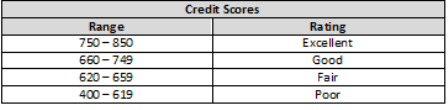
As a result of the Fair Credit Reporting Act (FACT Act), consumers are eligible to obtain a free credit report from the three major credit bureaus on an annual basis.  To obtain yours, visit www.annualcreditreport.com.  Although your credit reports are free, there is a nominal fee for the related credit scores.  A credit score is a numeric value that ranks you according to the information included in your credit report at a given point in time.  Credit scores typically range from 400-850; the higher, the better.  The table below provides the range for credit scores:

If you’ve obtained your credit reports and scores and are discouraged because of the story yours tells, all is not lost.  Over time, you can improve your credit rating.  The following six steps are essential components of an effective credit restoration plan:

  1. Pay your bills on time.  Do not allow your bills to exceed 30 days past due
  2. Correct false information in your credit report.  A survey conducted by the U.S. Public Interest Research Group (U.S. PIRG) concluded that 79% of all credit reports contain errors  
  3. Settle charge-off accounts, collections, and other past judgments; address most recently reported derogatory information first.  Your credit report will include contact information for your creditors; use it to negotiate terms for paying off outstanding debts.  It is very important that you honor the agreed upon terms
  4. Keep revolving account (credit card) balances below 50% of your credit limit
  5. Contact creditors to add positive information to your credit profile
  6. Do not “lend” your credit to anyone.  In all likelihood, if they need to use your credit, it’s because they’ve ruined their own.  Don’t allow them to ruin yours

Improving your credit rating takes time.  However, it can only be accomplished if you are aware of the problem.  Ultimately, accept responsibility for your choices.  If others have contributed to your negative credit rating, it’s still your responsibility unless you are a victim of identity theft.  To learn more about identity theft, visit www.ftc.gov.  Remember, taking ownership of your future means understanding the impact of decisions from your past.

Say NO To Refund Anticipation Loans

The process of filing one’s taxes is filled with great anticipation for some.  If you are making a beeline to your mailbox or your company’s website to obtain your W-2, you are likely in the group of taxpayers that expect a sizeable tax refund.  Additionally, there’s a high probability that you may utilize a tax preparation service and apply for a Refund Anticipation Loan (RAL).

According to the Consumer Federation of America (CFA), a RAL is a costly bank loan that is secured by a taxpayer’s expected refund, and carries an effective annual interest rate (APR) of approximately 149%.  This is almost five times worse than the default rate on most credit cards.  Believe me, I understand the desire to get your refund quickly, but you should never take out a loan to obtain money that’s owed to you.  Additionally, you should know that if the IRS reduces your refund for any reason, the entire amount of the RAL must be paid in full – hence, you will have to pay back the money out of pocket.

In the past, the IRS helped lenders minimize the chance of taxpayers receiving a RAL that would not be covered by their refund through the use of a debt indicator service.  This service was similar to a credit check; it revealed whether or not a taxpayer’s refund would be paid or used to cover government debts (e.g., taxes, outstanding child support, etc.).  In August 2010, the IRS announced that it would stop providing the debt indicator service.  While this news will not eliminate RALs, it will make them more difficult to get, and the associated fees will be even higher than they were before.

So, who are RALs targeted to?  According to the CFA, RALs are particularly targeted to low-income working families that claim the Earned Income Tax Credit (EITC).  In fact, over half of all RAL borrowers are EITC recipients – individuals that cannot afford to pay exorbitant fees to obtain their money.  Additionally, during a national survey commissioned by the CFA, it was concluded that RAL users are more likely to rent instead of own their homes; utilize high cost financial services, such as rent-to-own, payday loans and pawnshop loans; and a significant number of them are African American females. 

Given the information above, I urge you to consider doing something different this year.  There are services available to help you get your money quickly, and without the excessive fees that are associated with RALs.  Included below are quick, cost-effective methods for obtaining your tax refund:

  • On January 13, 2011, the U.S. Department of Treasury announced a pilot project to offer 600,000 low-cost, prepaid debit cards to families who may not have a bank account.  Consumers that receive the Treasury letter can quickly obtain the card to use for receiving this year’s tax refund
  • Open a savings account if you don’t have one, visit the I-CAN! E-File site (www.icanefile.org) or the IRS site (www.irs.gov), and file your taxes for FREE on your own! 
  • Visit a Volunteer Income Tax Assistance (VITA) or AARP Tax-Aide site.  They will e-File your taxes for you.  Tax-Aide sites save taxpayers money by eliminating the cost of RALs and tax preparation fees.  To find a location near you, call (1-800-906-9887) or visit www.irs.gov

Now that you know better, you should choose to make better choices. After all, why pay for something that you can get for free? As you prepare to file this year’s taxes, commit to the following:

  1. Stay away from RALs and consider utilizing one of the tax preparation services noted above
  2. Open a savings account if you don’t have one.  According to a study conducted by Insight Center for Community Economic Development, people of color are almost five times less likely than Whites to have a bank account
  3. Deposit the fees that you would have paid on a RAL into your savings account to begin your nest egg.  According to CFA, the average fees for an RAL (including tax preparation fees) are  approximately $300

Remember, small steps can lead to significant change!

« Older Entries Recent Entries »