Category Archives: wealth

Get Your Credit Straight!

One of the most important things to remember in wealth creation is your credit rating is important.  If anyone tells you it’s not, it is very likely that they are credit challenged.  The reality is, in spite of well thought out plans and precautionary measures, life happens.  It can be an illness or a leaky roof.  At some point in your life, the unexpected will occur and it will cost you.  Additionally, in today’s society, in order to obtain basic necessities (e.g., job, insurance, etc.), a good credit rating is required.

I know there can be several reasons for impaired credit, and that a poor credit rating does not mean you’re a bad person.  However, many organizations rely on information in your consumer credit report to assess your integrity and how well you honor your commitments.  Today’s job market is very competitive; you don’t want to win the job, but lose out on employment because a consumer credit review revealed poor judgment.

Poor credit is costly.  What’s most alarming is if asked, many of us don’t know our credit rating, and have never reviewed our credit report.  How can you change something when you’re unaware?  You don’t want to sit across the table from an employer or creditor and realize that they have access to information about you that you don’t have.  It can be a very embarrassing experience.  First and foremost, you are responsible for the consumer choices you make.  Your credit reports and scores are merely the result of your choices – your report card.

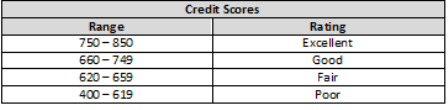
As a result of the Fair Credit Reporting Act (FACT Act), consumers are eligible to obtain a free credit report from the three major credit bureaus on an annual basis.  To obtain yours, visit www.annualcreditreport.com.  Although your credit reports are free, there is a nominal fee for the related credit scores.  A credit score is a numeric value that ranks you according to the information included in your credit report at a given point in time.  Credit scores typically range from 400-850; the higher, the better.  The table below provides the range for credit scores:
If you’ve obtained your credit reports and scores and are discouraged because of the story yours tells, all is not lost.  Over time, you can improve your credit rating.  The following six steps are essential components of an effective credit restoration plan:

  1. Pay your bills on time.  Do not allow your bills to exceed 30 days past due
  2. Correct false information in your credit report.  A survey conducted by the U.S. Public Interest Research Group (U.S. PIRG) concluded that 79% of all credit reports contain errors  
  3. Settle charge-off accounts, collections, and other past judgments; address most recently reported derogatory information first.  Your credit report will include contact information for your creditors; use it to negotiate terms for paying off outstanding debts.  It is very important that you honor the agreed upon terms
  4. Keep revolving account (credit card) balances below 50% of your credit limit
  5. Contact creditors to add positive information to your credit profile
  6. Do not “lend” your credit to anyone.  In all likelihood, if they need to use your credit, it’s because they’ve ruined their own.  Don’t allow them to ruin yours

Improving your credit rating takes time.  However, it can only be accomplished if you are aware of the problem.  Ultimately, accept responsibility for your choices.  If others have contributed to your negative credit rating, it’s still your responsibility unless you are a victim of identity theft.  To learn more about identity theft, visit www.ftc.gov.  Remember, taking ownership of your future means understanding the impact of decisions from your past.

Say NO To Refund Anticipation Loans

The process of filing one’s taxes is filled with great anticipation for some.  If you are making a beeline to your mailbox or your company’s website to obtain your W-2, you are likely in the group of taxpayers that expect a sizeable tax refund.  Additionally, there’s a high probability that you may utilize a tax preparation service and apply for a Refund Anticipation Loan (RAL).

According to the Consumer Federation of America (CFA), a RAL is a costly bank loan that is secured by a taxpayer’s expected refund, and carries an effective annual interest rate (APR) of approximately 149%.  This is almost five times worse than the default rate on most credit cards.  Believe me, I understand the desire to get your refund quickly, but you should never take out a loan to obtain money that’s owed to you.  Additionally, you should know that if the IRS reduces your refund for any reason, the entire amount of the RAL must be paid in full – hence, you will have to pay back the money out of pocket.

In the past, the IRS helped lenders minimize the chance of taxpayers receiving a RAL that would not be covered by their refund through the use of a debt indicator service.  This service was similar to a credit check; it revealed whether or not a taxpayer’s refund would be paid or used to cover government debts (e.g., taxes, outstanding child support, etc.).  In August 2010, the IRS announced that it would stop providing the debt indicator service.  While this news will not eliminate RALs, it will make them more difficult to get, and the associated fees will be even higher than they were before.

So, who are RALs targeted to?  According to the CFA, RALs are particularly targeted to low-income working families that claim the Earned Income Tax Credit (EITC).  In fact, over half of all RAL borrowers are EITC recipients – individuals that cannot afford to pay exorbitant fees to obtain their money.  Additionally, during a national survey commissioned by the CFA, it was concluded that RAL users are more likely to rent instead of own their homes; utilize high cost financial services, such as rent-to-own, payday loans and pawnshop loans; and a significant number of them are African American females. 

Given the information above, I urge you to consider doing something different this year.  There are services available to help you get your money quickly, and without the excessive fees that are associated with RALs.  Included below are quick, cost-effective methods for obtaining your tax refund:

  • On January 13, 2011, the U.S. Department of Treasury announced a pilot project to offer 600,000 low-cost, prepaid debit cards to families who may not have a bank account.  Consumers that receive the Treasury letter can quickly obtain the card to use for receiving this year’s tax refund
  • Open a savings account if you don’t have one, visit the I-CAN! E-File site (www.icanefile.org) or the IRS site (www.irs.gov), and file your taxes for FREE on your own! 
  • Visit a Volunteer Income Tax Assistance (VITA) or AARP Tax-Aide site.  They will e-File your taxes for you.  Tax-Aide sites save taxpayers money by eliminating the cost of RALs and tax preparation fees.  To find a location near you, call (1-800-906-9887) or visit www.irs.gov

Now that you know better, you should choose to make better choices. After all, why pay for something that you can get for free? As you prepare to file this year’s taxes, commit to the following:

  1. Stay away from RALs and consider utilizing one of the tax preparation services noted above
  2. Open a savings account if you don’t have one.  According to a study conducted by Insight Center for Community Economic Development, people of color are almost five times less likely than Whites to have a bank account
  3. Deposit the fees that you would have paid on a RAL into your savings account to begin your nest egg.  According to CFA, the average fees for an RAL (including tax preparation fees) are  approximately $300

Remember, small steps can lead to significant change!

What A Difference A Day Makes

I’m sure that you’ve heard about Ted Williams by now.  If not, Google “ted williams” to get a recant of his awe-inspiring story.  As I’ve followed the news, I have been struck by how quickly life happens.  I’ve also thought about how the decisions we make each day can position us for success or activate a derailment in our lives.

This story really pulled at my “heart strings”.  If we’re truthful, every one of us knows someone like Ted Williams.  In fact, there’s likely a little bit of Ted Williams in each of us; past failures or poor decisions paralyze us from stepping out and using our talents to pursue our dreams.  What dream have you deferred because of past mistakes?

Another person of interest in this story is Doral Chenoweth III, the videographer that showed compassion and took action.  How often do we discount people because of their circumstances?  Mr. Chenoweth had to first look beyond Mr. Williams’ outward appearance in order to have a conversation and uncover his gift.  We should all be mindful of our interactions with others.  After all, the person that you dismiss could very well be a bridge to your destiny. 

I’ve read the headlines about Mr. Williams’ criminal past, and I know some may think that he’s undeserving of this opportunity.  I believe that we’ve all been blessed with an opportunity at one time or another that we didn’t deserve.  Others may say, “What did he really do?  He was a panhandler that is now an overnight phenomenon!  He was not positioning himself for success!” I must disagree with you on this point.  Albeit unconventional, he promoted his gift.  His sign said the following:

“I have a God given gift of voice.  I am an ex-radio announcer who has fallen on hard times.  Please, any help will be greatly appreciated.  Thank you and God bless.”

How often do we promote our talents and skill sets?  In fact, many of us don’t believe in self-promotion.  And, if around others that do it, we perceive them as arrogant or cocky.  T. Harv Eker says it best, “successful people believe in self-promotion.”   

Personally, I pray that he succeeds.  He has been given an awesome gift, another chance.  If given the opportunity, are you ready for your big break?  I want to hear from you.  How do you feel about the instant fame of the man with the golden voice?

« Older Entries Recent Entries »